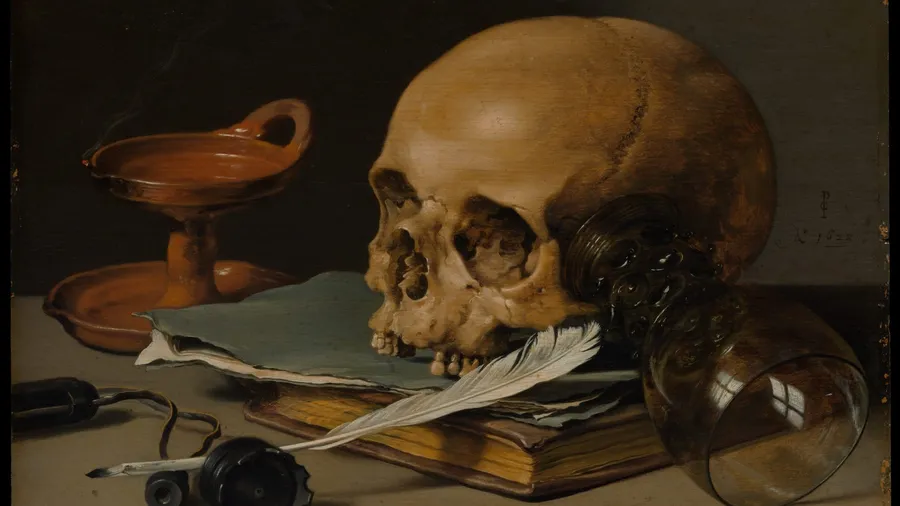
A perfect cosy read. A lovely story. Well not really, more like a kind of disturbing but addictive and sort of magical story. Highly recommend it.
Ninth House explores the intricacies of Yale and its secret societies everyone is itching to learn more about. We dive into a world of magic, demons, dark rituals, and power imbalance. Leigh Bardugo approaches the subject under the guise of magic, making it all the more enticing. Setting a scene of cold winters, fall evenings and Gothic architecture, this book makes one eager for autumn to arrive.
The main character, Alex Stern, is snarky, abrasive and full of sharp edges. Very refreshing compared to the soft, book loving girly we would usually get. Personally, I adored the mystery essence of the story, both regarding the magic system which was well thought out, and the question marks set throughout the story about our main characters’ backstories. Embracing the dark academia aesthetic to the fullest, making us wish we could be part of this universe whilst simultaneously pointing out the very disturbing things taking place on campus.
My usual issue with dark academia books is that the protagonists are usually college kids, feeling superior just because they speak Latin and Greek (e.g., The Secret History, Babel). This wasn’t the case here. There is more depth to the characters, an interesting backstory, and compelling motivations for their actions. Witty and funny at times. No small feat for such a dark book. Nevertheless, the novel’s pacing can be confusing at times. Throwing the reader from the present to the recent past and then even further back. Sometimes this change can happen within the same chapter, making you question the order of things.
The spoilers
Trigger warning: This book contains descriptions of sexual violence that, frankly, are not treated with the respect they deserve.
There is something about Leigh Bardugo’s work that leaves you craving more. It often feels as though her stories could be more fully developed, we could explore the characters more deeply and see their relationships in a different light. It is quite hard to explain, but essentially she opens up these plot lines and never fully finishes them, or only half-finishes some of them. When the story concludes, we never quite get that sense of fulfilment; it always feels like something is missing. This is why Bardugo’s books will never be 5/5 for me, they always lack something.
Hell Bent
Unfortunately, the plot line of Hell Bent was a bit weak. Why is this powerful demon prince, Golgarot, so hellbent on trapping 5 random people? We never get a strong enough motive. Golgarot was offered Darlington as a meal, I suppose, but isn’t it strange that he’s willing to go such lengths not only to keep him but capture his friends as well?
In a book where magic is non-traditional, people are multifaceted rather than simply good or evil, and hell is just another realm, it feels like an odd choice to make the demons plain villains who only wish to capture our heroes. Why? For what purpose? To torture them? To enslave them?
It is never explained, which leads me to believe that Bardugo assumes it is a given. In other words, she did not really create a new vision of hell, as she has suggested, but simply used the biblical one in her story instead.
Despite that, the world-building remains strong, the characters are interesting, and Bardugo’s writing is, as always, top tier. The dark atmosphere of the series is present throughout the story, serving as a reminder that this twisted universe could very well be part of the real world.
Overall rating 4.5/5 *

Art created by @meridyan_ar
Leave a Reply